


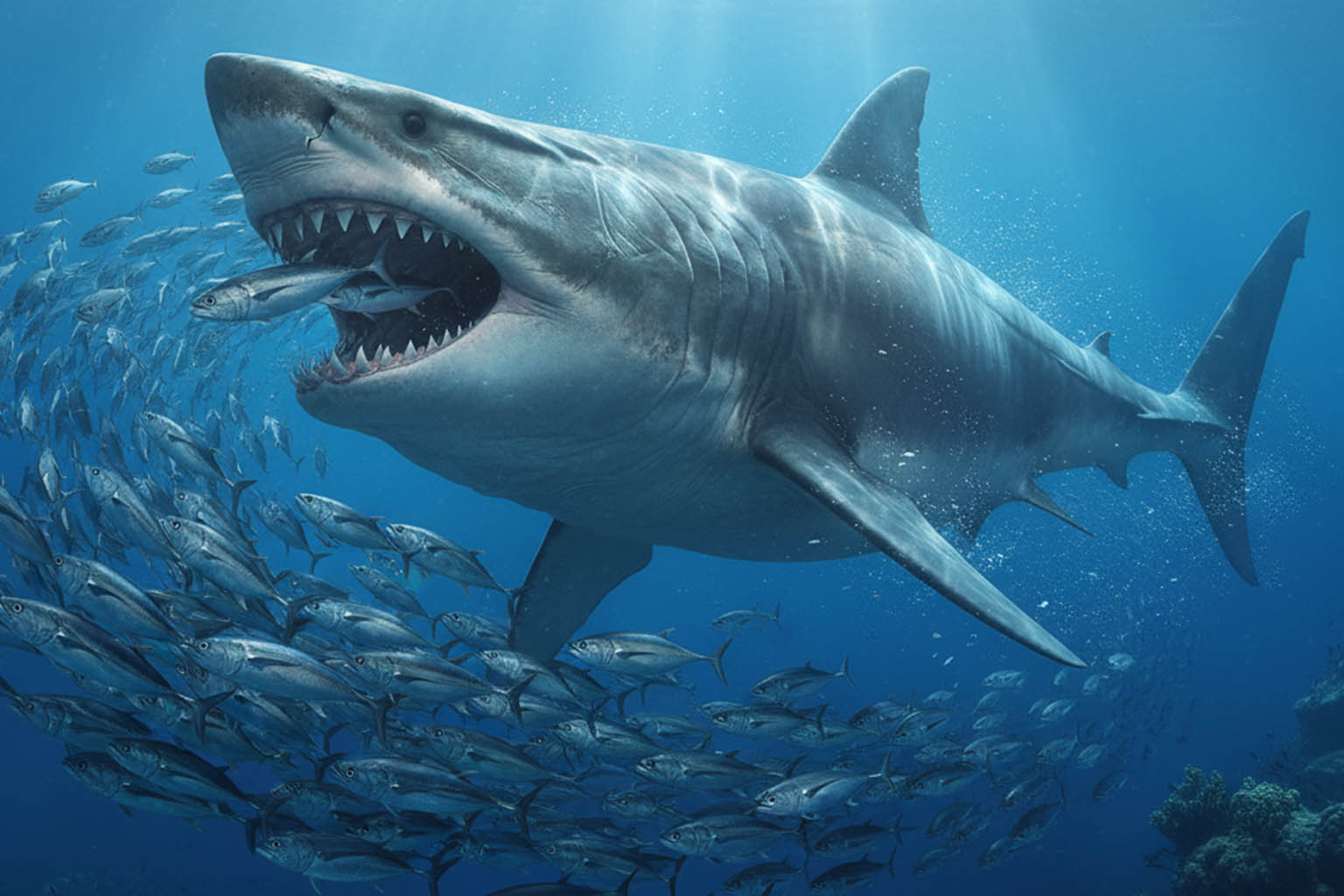
Imagine a prehistoric shark so colossal that it dominated the ancient oceans for nearly 20 million years. The megalodon, often depicted as a ruthless whale hunter, turns out to have been far more versatile. Recent research reveals this giant predator didn’t survive by specializing in just one type of prey, but by eating whatever it could find—showcasing an adaptability that defined its reign beneath the waves.
Megalodon’s Diet: More Than Just Whale Hunting
The megalodon has long been imagined as an apex hunter focused on feasting on whales. However, a groundbreaking study led by Jeremy McCormack at Goethe University Frankfurt challenges this narrative. By analyzing 209 fossilized teeth from various marine species, including megalodon relatives, researchers found compelling evidence that this giant shark had a more opportunistic and varied diet than previously believed.
Rather than solely preying on whales, the megalodon likely consumed a broad range of marine creatures, from smaller fish to other sharks. This flexibility would have been a significant survival advantage, allowing it to thrive even as ocean ecosystems fluctuated over millions of years.
Using Teeth to Unlock Ancient Diets
The secret to understanding megalodon’s feeding habits lies in the chemistry of its teeth. McCormack’s team examined the zinc isotope ratios in teeth fossils from two early Miocene sites in southern Germany—Sigmaringen and Passau. Zinc-66 isotope concentrations serve as a biological marker to estimate an animal’s position in the food chain: the higher it feeds, the lower its zinc-66 levels.
“This method provides unique insights into shifts in marine food webs through geological time,” said Kenshu Shimada, a paleobiologist from DePaul University. Such research highlights how even fearsome predators like the megalodon were part of a complex ecological network, adapting to changing prey availability.
“Determining tooth zinc isotope ratios has once again proven to be a valuable instrument for paleoecological reconstructions,” McCormack explained.
Sharing the Top Spot in the Ancient Seas
Contrary to the image of the solitary ruler of the ocean, the megalodon shared its apex status with several other large sharks, including Otodus chubutensis and Araloselachus cuspidatus. These apex predators coexisted and likely competed for food, forming a dynamic and fiercely competitive food web.
Three distinct trophic levels emerge from the study’s analysis: sea bream at the base, mid-level predators like small sharks and dolphins, and a top tier comprising large predators including megalodon. Yet, megalodon was not always the uncontested king, as other large sharks also operated in the same ecological zone.
McCormack notes, “They were not concentrating on certain prey types. They must have fed throughout the food web, on many different species.” This broad spectrum feeding shows a level of ecological complexity that separates the megalodon from being a simple “whale-killer” stereotype.
The Role of Competition in Megalodon’s Extinction
One surprising insight from the study is the possibility that the great white shark (Carcharodon carcharias) contributed to the megalodon’s demise. While the great white was much smaller than the megalodon, this modern predator was likely more agile and ecologically efficient.
“Our new study demonstrates the diet overlap between the great white shark and megalodon,” Shimada said. This overlap could imply direct competition for resources.
Experts believe this competition, combined with environmental changes, could have eventually driven the megalodon extinct. Despite its massive size—and fearsome bite—the megalodon may have lost the survival race to a more maneuverable rival.
The Giant Shark’s Legacy of Adaptation
Estimates on the megalodon’s size vary, with some models suggesting lengths up to 80 feet—potentially dwarfing the fictional monster from “The Meg.” Its massive, serrated teeth could measure up to 7 inches long, designed for grabbing and slicing through prey.
Yet, as the fossil evidence shows, it wasn’t sheer size that ensured the megalodon’s success. Rather, it was a remarkable adaptability—a willingness to exploit diverse prey sources across the marine food web—that sustained the species for millions of years.
“This suggests that the megalodon was not a mindless predator, but a strategic and versatile feeder,” McCormack said. This nuanced understanding adds depth to our picture of prehistoric marine ecosystems and highlights the fragile balance between predators and prey.
For those intrigued by ancient ocean mysteries, exploring these new insights about the megalodon’s diet offers a richer appreciation of how evolution shapes survival.
According to a ZME Science report published in 2024, this research not only changes how we view the megalodon but also enhances our understanding of oceanic food webs millions of years ago.
This article was researched and written by Jane Collins, senior marine science editor, with a focus on prehistoric ocean life and ecological dynamics.
If you found this dive into the megalodon’s diet fascinating, share your thoughts and reactions below. What surprises you most about this ancient predator’s adaptability? Let’s discuss!