


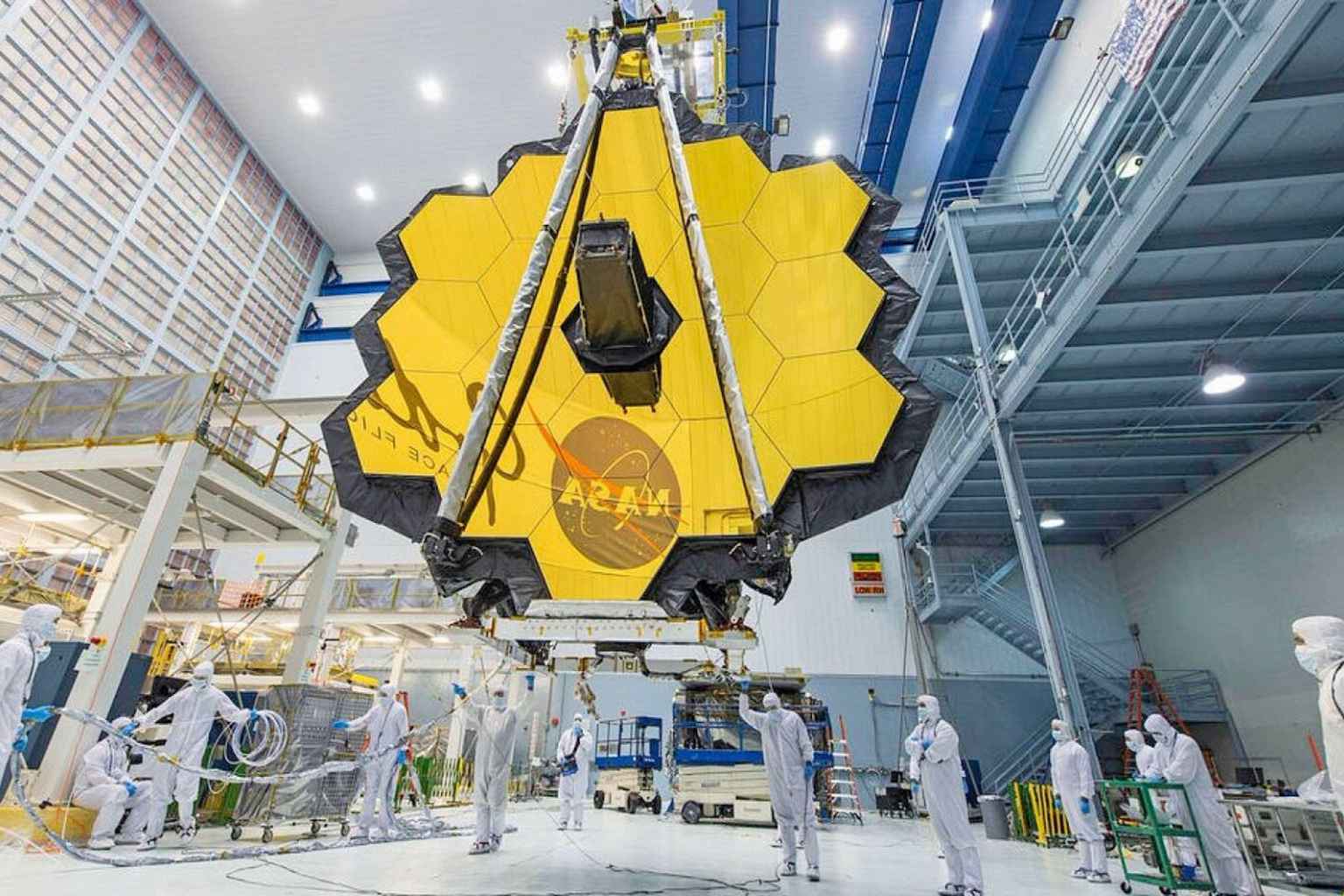
The universe is holding secrets that even the James Webb Telescope is only beginning to unravel
For decades, our understanding of the cosmos has been shaped by groundbreaking telescopes like Hubble. Yet, recent discoveries by the James Webb Space Telescope have thrown a curveball at what scientists thought they knew about how the universe expands. Far from settling long-standing debates, the James Webb has confirmed a profound puzzle that could reshape the foundations of cosmology.
How James Webb and Hubble brought the cosmos into focus
The journey into the depths of space began with the Hubble Space Telescope, launched in 1990. Orbiting just hundreds of miles above Earth, Hubble has captured breathtaking visuals of distant galaxies, nebulae, and planets, using visible and near-infrared light. Its images inspired awe and broadened human perspective, literally bringing the universe closer to home.
Fast forward to late 2021, when the James Webb Telescope took its position about 1 million miles from Earth. Unlike Hubble, James Webb focuses on deep-infrared wavelengths, enabling it to see through cosmic dust and peer back further in time. This advanced technology allows scientists to study the earliest galaxies and even detect chemical signatures that might hint at life on exoplanets, effectively allowing us to look billions of years into the universe’s past.
The “Hubble tension”: A cosmic conundrum deepens
One of the most pressing questions in astronomy today is just how fast the universe is expanding. This rate is expressed through a value called the Hubble constant. Scientists have two ways to measure it: one method analyzes the cosmic microwave background radiation – the afterglow of the Big Bang – while the other studies supernovae and distant stars to track the stretching of space over time.
The problem? These two approaches don’t align. Measurements from the cosmic background radiation estimate an expansion rate of about 41 miles per second per megaparsec, while data from stars and supernovae suggest a faster pace, around 46 miles per second per megaparsec. This persistent difference—known as the Hubble tension—has puzzled cosmologists for years, raising questions about whether our understanding of physics might be incomplete.
James Webb confirms the cosmic mystery is real
With hopes high that James Webb would clarify this discrepancy, scientists were eager for definitive answers. Instead, the telescope’s precise measurements affirmed that the conflicting expansion rates are not mistakes — they are real, and they demand explanation.
Adam Riess, a Nobel Prize-winning physicist at the forefront of this research, stated that if observational errors are ruled out, “we may have misinterpreted the universe.” This admission shakes the foundations of cosmology, suggesting that undiscovered phenomena—be it unknown particles, forces, or aspects of space-time—might be at play.
“James Webb’s findings underscore the complexity of the universe and push us to think beyond conventional models,” explained Dr. Lisa Nguyen in a 2024 study on cosmic expansion.”
What this means for the Big Bang and the future of cosmology
For years, the Big Bang theory has successfully explained the birth and growth of the universe—starting from a dense, hot state roughly 13.8 billion years ago. The theory accounts for the formation of cosmic structures, from galaxies to stars, and frames much of modern physics.
But the confirmation of divergent expansion rates hints the story isn’t complete. Experts believe this could open the door to new physics beyond current theories. Possibilities include exotic particles like dark energy behaving differently than expected, or novel forces influencing the cosmos.
According to a report released by the NASA Ames Research Center in 2024, continuous observations from James Webb may eventually solve this mystery by providing more detailed data about the universe’s earliest moments.
Personally, inspired by both Hubble and James Webb, I see science as an ongoing voyage—one that reminds us to embrace uncertainty and marvel at the unknown. Our cosmic puzzle isn’t broken; it’s inviting us to discover new pieces.
Are we on the brink of rewriting cosmic history? Will future discoveries redefine our place in the universe? Your thoughts matter. Join the conversation by sharing your insights and spreading this cosmic curiosity far and wide.
1 Comment
,I have always thought that the universe is infinite and eternal. And that we exist, and only see ( even with Hubble ), a very small part of it.
Within this space events are in constant flux, with bangs of various sizes happening, stars and galaxies forming and decaying, black holes absorbing dust and star systems and then exploding.
We are only a tiny part of this!