


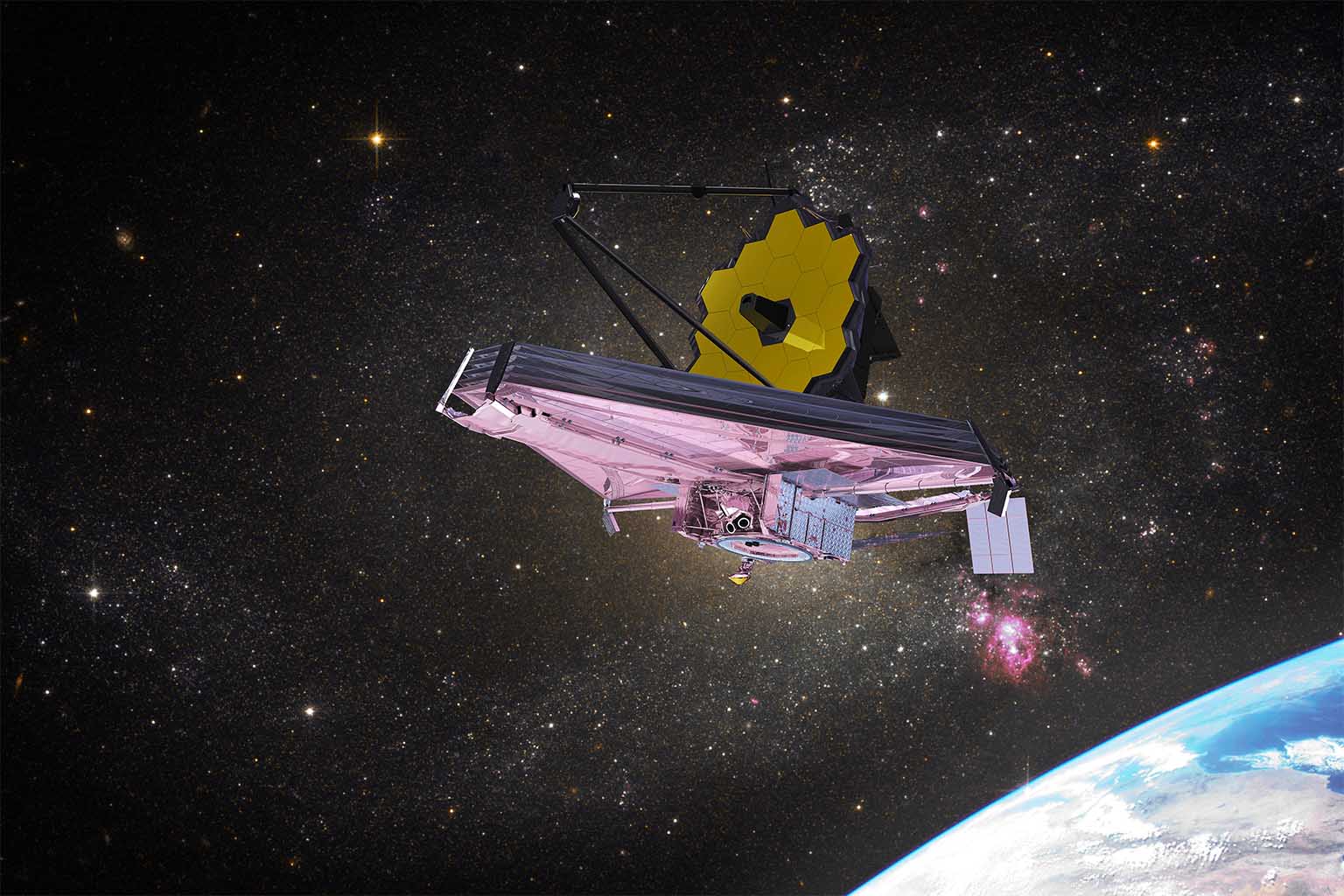
The universe has just whispered a secret that might change how we see life itself. Thanks to the powerful eyes of the James Webb Space Telescope, scientists have detected complex organic molecules in a distant galaxy—offering a thrilling glimpse into how life’s chemical roots might reach far beyond our Milky Way.
This groundbreaking detection suggests life’s building blocks could have existed across the cosmos for far longer than previously imagined, opening new frontiers in the search for life beyond Earth.
The extraordinary discovery in the Large Magellanic Cloud
Floating some 100,000 miles away would be an astronomical understatement—actually, the Large Magellanic Cloud (LMC) sits about 160,000 light-years from Earth. This dwarf galaxy orbits our Milky Way like a cosmic companion, a small star-studded sister that holds clues to what the young universe looked like.
Within this remote galaxy, the James Webb telescope, equipped with its powerful Mid-Infrared Instrument (MIRI), captured unprecedented signals around a young proto-star known as ST6. What they found was staggering: complex organic molecules trapped in icy mantles swirling around this stellar nursery. This marks the first time such chemistry has been unambiguously observed outside our home galaxy.
Dr. Marta Sewilo, an astrophysicist at NASA, emphasized the quality of the data collected. She stated the infrared spectra were so precise they allow researchers to confidently identify molecules such as methanol, ethanol, acetic acid, and methyl formate. These are substances commonly found on Earth—in everything from alcoholic beverages to vinegar and many industrial processes. But detecting them among the stars, especially in a distant galaxy with fewer heavy elements, is revolutionary.
Among these, there is also a tantalizing hint of glycolaldehyde, a simple sugar related to the formation of RNA, the fundamental molecule of life. While this signal remains tentative, its potential presence is wildly exciting, hinting at prebiotic chemistry occurring far beyond our Milky Way.
Why finding organic molecules in a metal-poor galaxy matters
The Large Magellanic Cloud is known for its low metallicity—it contains about a third as many heavy elements like carbon, nitrogen, and oxygen compared to our galaxy. These elements are essential building blocks for life as we know it. So how could such a chemically sparse environment harbor an abundance of complex organic molecules?
This discovery challenges our assumptions. It shows that even in what seem to be “element-poor” environments, the universe can still brew the ingredients necessary for life. The James Webb’s observations imply that the chemistry underpinning life is far more resilient and universal than previously thought.
Experts believe this snapshot of the LMC is like looking back in time at the early Milky Way, offering valuable insights into how organic chemistry might have unfolded billions of years ago.
The significance goes beyond mere molecule detection—it’s evidence that life’s chemical precursors may emerge almost anywhere in the cosmos, even under conditions once assumed unfavorable.
Reimagining the cosmic origins of life
This detection has profound implications for how scientists think about the prevalence of life beyond Earth. If complex organic compounds, the precursors to biological molecules, can form and persist in another galaxy, might life itself arise more easily and more widely than we imagine?
Renowned astrophysicist @HubertReeves long advocated this idea: that the ingredients and pathways to life are an inevitable outcome of cosmic chemistry. Other respected voices, like Jean-Pierre Bibring, urge careful interpretation. But as cosmic discoveries accumulate, the possibility of life elsewhere gains increasing credibility.
A 2023 study published by the European Southern Observatory supports this view, concluding that complex organic chemistry is common even in primitive galaxies. This challenges the notion that life-building molecules require metal-rich environments, fundamentally reshaping astrobiology’s map.
“We are witnessing the universality of organic chemistry in space, an essential step on the path from chemistry to biology.” – Dr. Marta Sewilo, NASA Astrophysicist
What this means for humanity’s cosmic quest
Finding organic molecules in the Large Magellanic Cloud is more than a scientific milestone—it’s a beacon that shines light on our own cosmic origins. It invites us to rethink the timeline and distribution of life in the universe.
Rather than life being a rare fluke confined to our tiny blue planet, these findings suggest life’s chemical roots might have been sown across galaxies for billions of years. The James Webb telescope’s revelations inspire optimism for future missions exploring exoplanets and distant star-forming regions.
For those fascinated by the origins of life and the universe’s mysteries, this discovery marks a pivotal point—a testament to humanity’s desire to understand its place in the cosmos.
To explore further, watch this video :
Does this extraordinary cosmic chemistry change your outlook on life beyond Earth? Share your thoughts and join the conversation below. Your perspective enriches our collective journey through the stars.