


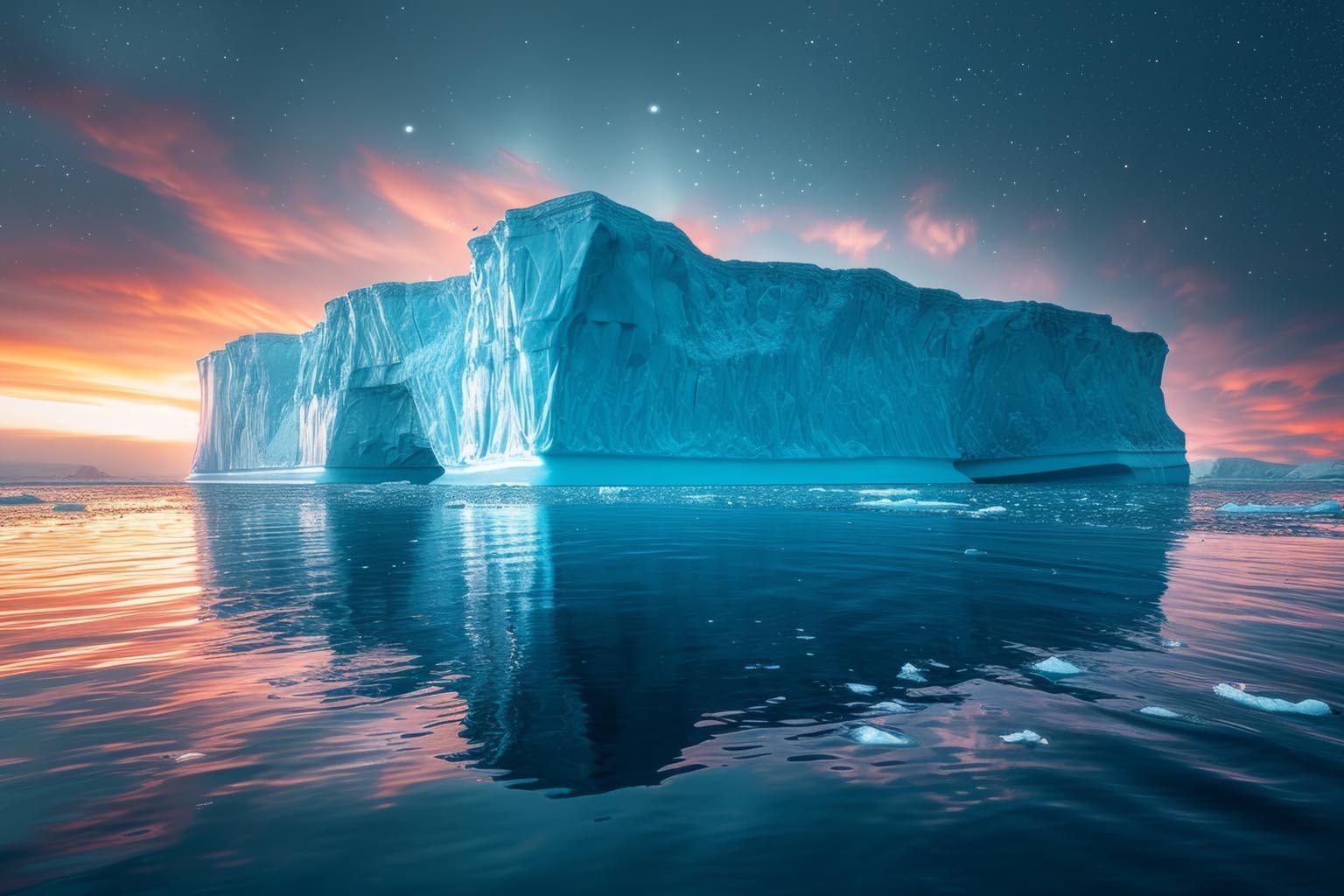
An enormous iceberg breaking away in Antarctica has unveiled a hidden world beneath the Southern Ocean, igniting excitement among scientists worldwide. For the first time ever, researchers have captured live footage of some of the ocean’s most elusive deep-sea creatures, transforming our understanding of Antarctic marine life.
A Remarkable Antarctic Event Reveals the Unknown
In January 2025, the Antarctic landscape witnessed a dramatic transformation when the colossal iceberg A-84 calved from the George VI Ice Shelf. This event exposed a previously hidden stretch of seafloor, offering an unprecedented opportunity for marine biologists to explore uncharted territories beneath the frigid Southern Ocean.
This extraordinary natural phenomenon allowed scientists aboard the research vessel R/V Falkor, operated by the Schmidt Ocean Institute, to capture groundbreaking footage of deep-sea creatures that had long evaded direct observation.
The First Live Glimpse of the Glacial Glass Squid
On January 20, 2025, the research team achieved a historic breakthrough by recording the very first live footage of the elusive glacial glass squid (Galiteuthis glacialis) at a depth of 2,254 feet (687 meters). Previously, sightings of this translucent squid had been limited to dead specimens found in fishing nets or inside whale stomachs, offering little knowledge about its natural behavior.
Discovered over a century ago in 1906, the glacial glass squid remains one of the ocean’s most mysterious dwellers. Thanks to the iceberg’s calving, scientists finally glimpsed this creature thriving in its natural environment, unlocking new paths for studying deep-sea ecosystems.
Unveiling the Majestic Colossal Squid
The excitement continued on March 9, 2025, when the same team captured first-ever live footage of the colossal squid (Mesonychoteuthis hamiltoni), a creature famous for its gigantic size and nearly transparent body. This deep-sea predator can grow up to 23 feet (7 meters) long—massive compared to the smaller glacial glass squid.
While both squid species share some hunting adaptations like distinctive hooks, they differ substantially. The colossal squid’s hooks line the middle sections of its arms, whereas the glacial glass squid’s hooks sit at the tips of its elongated tentacles. These discoveries offer crucial insights into how these enigmatic creatures evolved to thrive in the extreme cold and darkness of the Southern Ocean.
Exploring Antarctica’s Mysterious Depths
Beyond these remarkable squid, the expedition encountered a fascinating array of Antarctic marine life, including icefish, giant sea spiders, and various octopus species. Dr. Jyotika Virmani, executive director of the Schmidt Ocean Institute, emphasized the expedition’s significance: “These unforgettable moments continue to remind us that the ocean is brimming with mysteries yet to be solved.”
This scientific mission highlights how little we know about the Antarctic deep sea, a realm that remains one of the most unexplored environments on Earth. Such studies not only expand our understanding of biodiversity but also underscore the ocean’s vulnerability in the face of climate change.
According to a 2020 study by Nature Scientific Reports, the Antarctic marine ecosystem is incredibly sensitive to environmental shifts, making it imperative to document its inhabitants and their habitats while such expeditions are still possible.
“Discovering live footage of these squids is a critical step in revealing the dynamics of Antarctica’s deep-sea food chain and how these species adapt to one of the planet’s harshest environments.” – Dr. Jyotika Virmani, Schmidt Ocean Institute
The Broader Implications for Marine Science
This extraordinary expedition underscores a fundamental truth: Antarctica’s deep oceans are brimming with undiscovered life forms and ecological secrets. Capturing live footage of creatures like the glacial glass squid and colossal squid not only fills critical knowledge gaps but also helps conservationists strategize for preserving fragile ecosystems.
As climate change accelerates ice melt and alters ocean conditions, the window to study these pristine habitats narrows. Initiatives by institutions like the Schmidt Ocean Institute exemplify global efforts to protect and understand our oceans before irreversible changes occur.
For readers fascinated by the deep sea or passionate about marine conservation, these stunning discoveries invite us all to appreciate the hidden wonders beneath the Antarctic ice—a front line for both scientific discovery and climate urgency.
Have these remarkable Antarctic revelations inspired your curiosity? We’d love to hear your thoughts. Share your reactions, questions, or insights in the comments below, and join the conversation about uncovering the mysteries of the deep ocean.